
At the Open Gov Hub, we strive to be more than a coworking and event space. We aim to foster a community that supports mutual learning, partnership and a sense of shared purpose. Over the past year, many of our members have faced new challenges as political upheaval transformed the landscape in which they work. In this more decentralized environment, it is especially valuable to reflect on how interconnected our community is, and on the untapped potential for new partnerships.
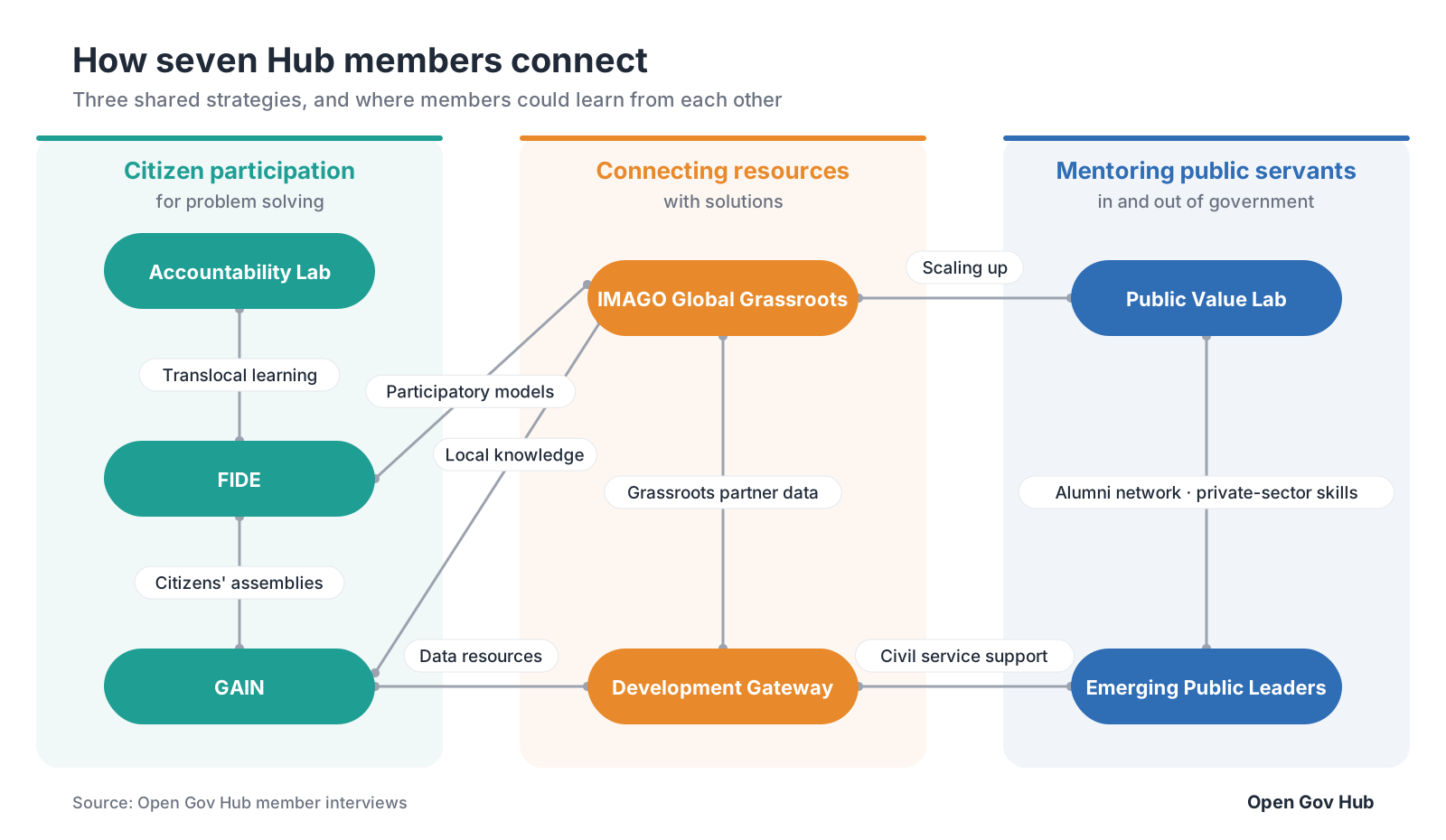
We began with a group of members working in the civic and global development sectors. In conversations with seven of them, we found that they share similar and complementary strategies for generating public value. Those shared strategies open the door to mutual learning and partnership. Three stood out:
Fostering citizen participation to solve public problems
Connecting resources with solutions through quality data and networks of knowledge
Mentoring and resourcing public servants, in and out of government
1. Advancing citizen participation
Advancing citizen participation is one of the main ways our members help solve public problems. Accountability Lab works translocally to build ecosystems of engaged citizens, bringing people together for shared conversations about anticorruption and effective government. These networks create unlikely connections between people with different experiences and interests. Participants learn from one another and develop accountability strategies that draw on expertise no single group possesses.
Because it works on participatory projects around the world, Accountability Lab can share insights with more domestically focused organizations. One example is the Federation for Innovation in Democracy – North America (FIDE), which partners with state and local governments to bring citizens' assemblies into the policy process. Citizens' assemblies draw on people's experience, values and capacity to deliberate in order to solve public problems. FIDE's model could help any organization looking to add new participatory frameworks to its programming.
Accountability Lab may find citizens' assemblies a useful model, and so might organizations further afield, such as the Global Alliance for Improved Nutrition (GAIN). One of GAIN's distinctive roles with governments and food value chain actors is helping institutions listen better to people with lived experience of food insecurity. Citizens' assemblies are exactly the kind of institutional mechanism that can improve government decision-making and build trust between stakeholders in food systems.
2. Connecting resources with solutions
Quality information matters beyond designing solutions. It is also essential for connecting the resources needed to put those solutions into practice. Development Gateway and IMAGO Global Grassroots both fill this role in different ways. Each gives action-oriented organizations and philanthropies the information they need to partner. Development Gateway specializes in building robust, transparent data platforms, while IMAGO focuses on scaling up networks of grassroots knowledge.
These organizations could help other Hub members secure funding. They could also partner with each other to broaden the scope and depth of their information. Academic data and evidence can be strengthened by grassroots organizations' firsthand knowledge of conditions on the ground, and checked against it. With higher-quality, more transparent data, grassroots efforts can scale more efficiently.
3. Mentoring public servants in and out of government
The third shared strategy is mentoring and resourcing the people who create public value, inside government and out. Emerging Public Leaders (EPL) is a pan-African organization whose public service fellowships recruit and train the next generation of civil servants. Public Value Lab, launched in 2025, is an incubator that helps former public servants build businesses so they can keep contributing to the public good through the private sector.
Their focuses seem different, but the two have models to share. Public Value Lab could build a network of cohort alumni to support current participants, as EPL has done. EPL, in turn, could add private-sector training for its fellows, drawing on Public Value Lab's curriculum.
Why it matters now
As the development and civic sectors become more decentralized, no organization can carry its mission alone. The seven members we spoke with approach public problems from different angles, including civic participation, data, nutrition, grassroots scaling and public service. Their strategies reinforce one another. Part of what makes that possible is proximity: several told us that sharing space at the Hub sparks the conversations that turn overlap into partnership.
This is the first in a series exploring how Hub members connect. Next, we'll look at members working on transparency and accountability.
Are you a Hub member who wants to be featured, or to meet one of the organizations above? Email us at info@opengovhub.org and we'll make the introduction.
Written by Thomas Gatzke, Open Gov Hub Catalyst (Spring 2026).
